Tuesday, May 31, 2011

Deconstructing Unique ID Enabled Micro ATM/m-Banking Business Model For Rural Poor in India

Let’s look at 3 disparate data pointsData point No 1: - India has close to 90 million farmer households (Ref: National Sample Survey. In 2001, average Indian household consisted of 5.4 people in rural areas and 5.2 people in urban areas). Of these, around 51% don’t have access to any credit from either institutional or non-institutional sources. Only 27% households are indebted to formal sources.

Data point No 2:- ‘No-frills’ accounts offered by banks in the recent past have not been very successful in terms of achieving financial inclusion of the unbanked populace. Given the typical cost-to-serve ratios in sparsely populated rural areas, banks find it extremely difficult to operate larger number of tiny accounts as well as micro-transactions profitably. A bank branch in India serves about 16000 people in India. This number is very high as compared to developed countries

Data point No 3:-Wireless telephony penetration rate in India is the highest in the world. As per TRAI (Telecom Regulatory Authority of India), number of mobile subscribers in India-as of Mar’11-is 811.59million (~81cr), growing at a healthy 3% month-on-month rate. The share of urban subscribers stands at 66% (~54cr) and the rest @34% (~27cr) comes from the rural area.

What do these data points indicate?
These data points, looked at in a joined up manner, indicate that 27cr rural Indians possess mobile phones but more than 50% (>14Cr) of these don’t have access to any credit from either institutional or non-institutional sources. In nutshell, there is a significant opportunity for banks to expand in rural areas, provided some innovation in business model is able to rationalize the cost-to-serve ratio for the aspiring banks
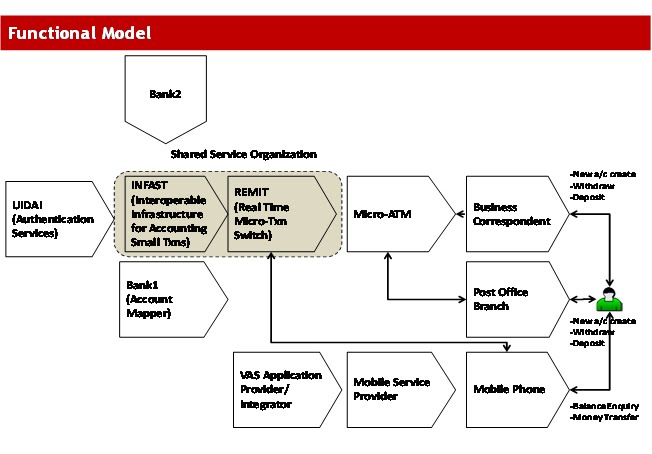
What are the key components of New Business Model for Banks?New business model for ensuring financial inclusion is shown in adjoining figure. Key value proposition is ‘no-frills’ account for rural unbanked people of India.
Besides Business Correspondent s and Sub-BCs, mobile phones and Micro-ATMs form an important distribution channel. Other than that the fact that Indian Post Office has over 1, 50,000 branches, of which more than 70% being located in rural India, presents an attractive option to banks for an alternate distribution channel. There is an opportunity for banks to leverage Post office’s rural presence for the effective service distribution at lower cost-to-serve ratio.

On the supply side, participating banks can form a ‘shared services organization’ (a la tower sharing companies in telecom sector) for creating and maintaining an interoperable infrastructure for small transaction accounting etc which will help take out the service delivery cost significantly. UIDAI being the key enabler in terms of providing authentication services for online mobile banking transactions. UIDAI services could be availed on transaction based costing model.

Saturday, December 18, 2010

Internet Enabled ‘Corporate Unbundling’ Business Model

John Hagel’s concept of ‘unbundling of corporate’ talks about a company being an unnatural bundle of three very different types of businesses- Infrastructure management business, customer relationship business and product innovation & commercialization business.
To me, the genesis of outsourcing industry is in having these 3 diverse businesses- with very diverse economics, skill-sets and cultures-tied together within a company . E.g. customer relationship business would thrive on ‘economies of scope’ whereas infrastructure business’s key financial KPI would be driven by ‘economies of scale’, ‘time to market’ would be the critical performance parameter for a product innovation business. When the margins come under pressure, CEOs would be faced with a tough choice of cutting the flab and sustaining the margins. In past, situations like this forced CEOs to do some soul searching and ask questions such as ‘what business are we really in?’ E.g. If the company was in the business of selling communication services/products, what business did it have to have in-house call centre or a software development or a product development department, thereby adding to opex and putting pressure on already strained margins.
Pondering over cost optimisation options led to the thought of outsourcing call centers, software development, product development etc to those locations, where these costs would be much lower and margins would be sustained, if not improved. Thus unbundling of corporate led to creation of an outsourcing industry in late nineties with ‘comparable services at lower cost’ being the key value preposition. Important point to note in this story is of enablement or facilitation of unbundling by rapid evolution of internet and communication technologies in late nineties. Internet’s recent prodigy ‘cloud computing’ is expected to take this corporate unbundling process to the next higher orbit.
First wave of ‘internet enabled unbundling (outsourcing)’ ensured margin sustenance by outsourcing call centers, software development and product development etc to those locations where resource cost base was much lower. Second wave of ‘cloud enabled unbundling’ is about saving capex (by eliminating the need to buy/own physical hardware, expensive software and capital intensive storage capacities for ‘in-life’ IT operations) as well as reducing the opex by running very thin IT operations and buying only the amount of computing power as required by the company for a pre-defined rental fee (‘on-demand’ service model). This will rid CIO of need to burn midnight oil planning capacities for cyclical nature of service uptake.
In India, cloudware application companies like Nustreet are actively leveraging this unbundling business model and running cloud based ‘subscription’ revenue model on Microsoft Windows Azure platform, which allows companies to begin using software applications (at a rental fee) almost immediately, with very minimal upfront investments in hardware or software licenses

Monday, July 5, 2010

Does Femtocell Address Coverage Woes Of Rural Telephony In India?

A smaller base station in Femtocell, which was originally designed to enhance cellular network's indoor service coverage could be deployed in coverage driven sparsely populated rural indian markets at much lower costs than traditional base station. This is possible using a new chip from Picochip, which could support as many as 32 active mobiles outdoor. This technological disruption could not only cut down the rural expansion costs for indian Telcos but also challenge the traditional macro basestation industry and the prevailing business model...

Saturday, March 27, 2010

New Business Model for Addressing the Energy Cost/Quality Issues of Telcos In Rural India

A typical cost of ownership (TCO) percentages for the components of Base Station System (BSS)- comprising of BTS/BSC- for an Indian Telco is shown in the adjoining figure. One could easily make out the 3 big ticket cost items from there-they are telecom equipment, power (16% of BSS TCO), and civil work in that order. As Indian Telcos take the next leap forward in terms of reaching out to rural markets (average rural teledensity being 19%), they are grappling with the challenges of reducing the TCO for the rural operations. Rural markets are low-ARPU market segments and thus the solutions for the rural market need to have a fundamentally different cost structure for the business model to become sustainable. Telco’s passive network (towers, shelter, ac equipment, diesel electric generators, battery and electrical connections) sharing is already in vogue; soon to be followed by the active network (base transceiver station, microwave, radio equipment, antennas etc) sharing, which will further drive down the cost on account of telecom equipment in a 'coverage' rather than 'capacity' driven fragmented rural telecom market.
Another big ticket cost item for Telcos is Power. Power in rural India poses a dual challenge. Apart from the higher consumption costs, Telcos are also grappling with the issue of lack of uninterrupted supply which is affecting their QoS to the customers severely. Various solutions like solar power etc have been talked about but the CAPEX associated with the solar power solution is prohibitive and hence has not been picked up much.
Here is my thought in terms of creating a new solar energy based business model which will directly address the second biggest cost item for the Indian Telcos.
No, it’s not about Telcos installing the solar panels. This would require making a huge capital investments upfront and being able to reap the benefits only after 15-20 years. We all know that selling solar installations to Telcos, though a good clean technology, does not necessarily make a good business case given the ROI imperatives. An Alternate approach is where the Telcos (where vertically integrated) or the Tower Sharing Company (TSC) could form a joint outsourced Solar PowCo (Power Generation/distribution Company), similar to the existing Tower Sharing Companies. This PowCo can then sell Solar Power Purchasing Agreements (SPPAs) to all the participating Telcos/TSC in that circle. This PowCo would then install and manage the solar installations with a committed power uptake from all the participating Telcos/TSC at a fixed price for a pre-defined period (say 10 years).To finance the investment in solar installations, PowCo would re-package the SPPAs and sell them to the investors. Investors then become the legal owners of the installations and thus reap the rebates and tax benefits associated with the green energy. SPPA payments would give the investors the same return on investments as any other energy. What does the PowCo get in return?. The PowCo gets paid fees by the investor for developing, monitoring and servicing the SPPAs.

This has a potential to bring down the TCO for power by almost 30-40% making Telcos so much more competitive in the rural market segment. SunEdisson has been successfully operating similar kind of model for other sectors of US economy. Reliance, Tata being the Power and the Telco Companies could have a head start with this business model.

Thursday, January 14, 2010

Why Publishing Cost Of Production (MCP) Would Be A Game Changer

As service industry grows in India, companies are innovating newer products/services and coming out with differentiated offerings to the market. Innovation is not only expected to trigger demand for newer products/services (topline) but also help sustain the margins (bottomline) in recession squeezed markets...marketeers seem to have (re) discovered the mantra to help boost the sagging sales/morales of their sales teams...so the key is to come up with 'non-commoditised' product or service offering to the market...

However the important dimension to this emerging story, from the consumer point of view is- how do i -a consumer- assess the 'fair price' or 'right value for money' for the non-commoditised product/services, before i make a decision in favour of or against buying that product/service
This question becomes extremely important especially for markets like India (and majority others for that matter) where the print and organised electronic media, supposedly an educater/emancipator of the masses, is bought over by the manufacturers of these goods and services (sponsored and paid news is (not so) unique feature of Indian democracy!!)...Consumer movements in India too have become dysfunctional and Govt is perpetually faced with a dilemma of whether or not to regulate the 'market forces'(!) and thus ensure fair price for the end consumer...

To me the answer lies in a simple change (first proposed in ninetees by an eminent Indian economist late Prof M.G. Bokare), which could be brought about by an act of parliament whereby a manufacturer will be mandatorily required to publish per unit cost of production along with MRP on every article they sell in the market. So one would have MCP (Max Cost of Production) and MRP (Max Retail Price) clearly dispalyed on e.g. bottle of mineral water or hotel bill..(fortunately, Cost Accounting practices have evolved enough in last decade to make this per unit cost calculation quite possible now)
What are the benefits:- there are many but the most important one, from a consumer perspective-with increasing number of non-commoditised (read innovative) products/services flooding the markets, consumer will precisely know the per unit cost of prodution (MCP) and the premium they are being asked to pay (MRP) over and above the cost price..Consumer will pay the premium if they really think its worth the benefits....going forward, this will definately ensure a fair pricing by the manufacturers of the goods/services or else consumer will make an 'informed decision' of not buying the product/service...real power to the consumer!!

Sunday, July 5, 2009

Microfinance Driven Emerging Business Models for Low Income Housing In India

A cursory look at the housing finance statistics underlines the compelling need for urban low income housing in India and explains the emergence of microfinance based new business models in this sector...despite liberal credit regime and the associated average 35%+ rate of urban housing finance growth in last decade, about 21 million (2.1 Crore) urban Indian population still can't afford to own a house..the reason..not so diifcult to comprehend...over 80% of urban housholds in India earn less than 220USD a month (@11,000INR at current conversion rate)...a houshold earning INR 11000 can only qualify for INR 4,50,000 worth of loan as per the housing finance guidelines (individual is entitled to home loan upto max 40 times his/her monthly income)...with INR 4,50000, one can hardly dream of owning a decent home in any tier I/II cities in India..clearly, there is an untapped customer base of @2 crore urbanites willing to buy a property in Indian cities....from the supply side, the housing finance companies have 2 major issues to deal with, before they open up the credit line to these potential buyers-1) high cost-to-serve ratio and 2) potential credit risk associated with perceived higher levels of defaults in this segment....

Demand slowdown in high income housing segment in last 2 quarters of 2008-09, , has compelled the housing finance and the realty developer companies to think in terms of innovative business models, which would help extend the credit line to these low income urbanites and at the same time address finance companys' concerns regarding issues such as high cost-to-serve ratio and defaults on repayments...The emerging business model is based on intermediary role of Self Help Groups (SHG-Bachat Gat), Mutually Aided Co-Op Societies(MACS/Daily Collections) as well as internal or external Micro Finance Companies (MFI) to bear the risk to recovery and also reduce high cost to serve ratio..MFIs are assumed to be performing the job of customer aggregation, first level screening and the critical debt recovery.. thus making this model sustainable...another supply side parameter impending this business model could be high land cost in urban areas...however thanks to demand slowdown in realty sector and the indications on part of Government to look at FSI relatd policy changes, land prices have seen some correction to the tune of @20-30% in most urban centres providing much needed impetus to low income housing in india...

Sunday, September 14, 2008

GDP Growth and Inflation Heading In Different Directions-What Policy Options Should Be Exercised?

The unusual combination of spiralling prices due to commodity driven inflation on one side and the credit crunch on the other has left many Govts worldwide in a unique situation these days. As the talk of slowdown becomes frequent, I'm tempted to look at series of policy mesures taken to avoid recession by the then Govts facing Asian crisis and the dotcom bust in late ninetees and compare with the present situation. Unfortunately the comparison ends there itself. The Principal reason being- both these crises in ninetees affected GDP growth and the inflation in much the same way. Central Banks could then resort to cutting the interest rates to bolster spending without bothering too much about the inflationary trends, not any more. Many developing as well as developed economies are reeling under double-digit inflation so the option of cutting the interest rate is no longer feasible. On the other hand, high interest rates are taking toll on industrial investment plans.. What are the options before policy makers?

My thinking is- from the time this crisis erupted last year, western economies have managed to stay away from deep recession on account of sustained export growth into emerging economies...obviously their policy stimulus would be/should be to sustain and improve this. For developing countries like India and China, the policy stimulus essentially has to be around sustaining the domestic consumtion boom led by domestic manufacturers/service providers
On the fiscal stimuli front, an important and a bold policy measure to consider would be to pronounce lower tax rate outlook for next 3-5 years period. This would go long way in instillng the confidence in the investors who generally in times like this, based on the perception of tougher fiscal policy ahead, are bent upon improving cash flows in longer term....

Monday, May 26, 2008

Strategy Dimension of Karnataka Elections 2008

Years ago, when i first came to UK and was coming out of Heathrow, an HSBC advertisement caught my attention...the message was 'Global Bank Local Culture'....

Since then, every time i looked at India and its federated polity and wondered why state after state was being captured by regional parties...importantly what could be the cure from national parties perspective...i was reminded of this message i had seen before....i felt 2 major national parties in India need to get this as a part of their startegy.....

Arun Jaitley's campaign strategy for Karnataka, i thought, was a clever mix of local culture (personified by B S Yedi) plus other issues such as betrayal, price rise etc...many people would recall NDTV corespondent repeatedly asking BJP leaders to explain the riddle about national party positioning and projecting itelf as a regional outfit-with BSY as its local Chieftain- in Karnataka.

I also think 'paanch karod Gujrati' stuff last year was no different....this strategy won him Gujarat last time and Karnataka this time around....

Question i have in mind is- Would Arun have similar 'mix' for MP, Chattisgarh and Rajasthan as well? or given these states have incumbent BJP Govts, he'd go for something different?......